
Radish. An Introduction.
The summer following my freshman year of college a friend and I got a plot at our University’s community garden. In mid-April, we turned over the soil, adding some fresh compost and wondering why we thought we could be entrusted with this responsibility. We scattered an assortment of seeds in neat little lines: radishes, kale, tomatoes, and lettuce. Wiping the dirt on our pants, we read the backs of the packets, radishes: 28 days to harvest… kale, 95 days to harvest. We doubted we’d ever come to see the fruits of our labor.
Each week I’d return to check on our progress. After one week, I was thrilled to see the seeds had germinated, and were replaced with hundreds of tiny sprouts.
Soon enough, we had radishes, their little red shoulders poking up out of the soil.
I’d never liked radishes much. They were just a vegetable with a bitter red bulb and prickly leaves. Up until then, I didn't see the point in radishes, except to garnish fish tacos.
I gleefully yanked my harvest up out of the soil, plopped it in a Styrofoam cooler floating around in the back of my car, and raced back to my dorm to enjoy the fruits of my labor. Over the following days, I fell in love with radishes. sliced up in salads, eaten plain, and yes, on tacos.
There’s a certain unavoidable reverence that comes from growing something yourself, preparing your own meal, or in some way feeling connected to where your food comes from. You can’t help but more deeply appreciate the miracle of what you’re enjoying.
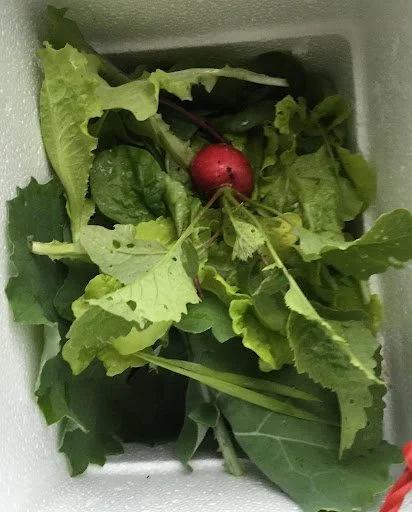
A very blurry photo of the first radish I grew
As Wendell Berry once wrote: “A significant part of the pleasure of eating is in one’s accurate consciousness of the lives and the world from which food comes”
This is the first installment of a monthly(ish) series: Starting Radish Farm Stop. Each month, I’ll be sharing stories, updates, and just generally more information about what we’re up to until we open this spring. Feel free to email me: Lily@RadishFarmStop.com with any questions, ponderings or suggestions as you read along, and please share this with your friends, family, and community.
A bit about me…
I should probably introduce myself. My name is Lily Gross.
Growing up, the kitchen was a gathering place for my family. It was where we talked through challenges, worked on homework, and learned how to cook our favorite recipes.
I think a lot of this was in part because of my parent’s backgrounds: My mom came from a family of dairy farmers, and my dad’s grandparents owned a Scottish bakery in Detroit. This meant that they grew up with an understanding of where their food came from, and knowledge of what went into producing quality products. For each of them, this resulted in a desire to share their appreciation of food with us. So, we tried our best to maintain a Midwest backyard garden, and retain secret Scottish baking traditions.
It's no wonder that I grew up fascinated with food and wanting to understand how the intimate relationship we have with food impacts our environment and our own wellbeing. This led me to major in Environmental Studies in college, learning as much as I possibly could about agriculture and our food.
That pursuit led to working & learning in several different roles:
Managing the Produce Department at Seward Co-op (most recently)
Assisting with campaign strategy & market research for a food marketing agency
Researching and presenting on food system issues with environmental clubs and climate change sceptics at colleges across the country on behalf of Bon Appetit Management Company.
Running social media for a small food startup incubator (KITCHENTOWN)
Fundraising for the San Francisco Ferry Plaza Farmers Market
In-store product sampling and sales for an upcycled granola bar company (Regrained)
I learned a lot from these experiences, but found myself still searching for a place where I could put my all into improving this complicated food system of ours. I couldn’t find it. I instead found a path towards building a business that combines my passion for community connection with a model that helps grow the local food economy: farm stops.
So, after several years of planning, I’m opening Radish Farm Stop in Minneapolis this spring.